
- Lar
- Produtos
- Rolamentos rígidos de esferas
- Rolamentos rígidos de esferas de aço inoxidável
- Rolamentos rígidos de esferas de aço inoxidável série SS 6000
- Rolamentos rígidos de esferas de aço inoxidável série SS 6200
- Rolamentos rígidos de esferas de aço inoxidável série SS 6300
- Rolamentos rígidos de esferas de aço inoxidável série SS 6700
- Rolamentos rígidos de esferas de aço inoxidável série SS 6800
- Rolamentos rígidos de esferas de aço inoxidável série SS 6900
- Rolamentos de esferas de contato angular
- Rolamentos de flange
- Rolamentos para fone de ouvido de bicicleta
- Sobre nós
- Aplicativo
- Notícias
- Contate-nos

Menu
- Lar
- Produtos
- Rolamentos rígidos de esferas
- Rolamentos rígidos de esferas de aço inoxidável
- Rolamentos rígidos de esferas de aço inoxidável série SS 6000
- Rolamentos rígidos de esferas de aço inoxidável série SS 6200
- Rolamentos rígidos de esferas de aço inoxidável série SS 6300
- Rolamentos rígidos de esferas de aço inoxidável série SS 6700
- Rolamentos rígidos de esferas de aço inoxidável série SS 6800
- Rolamentos rígidos de esferas de aço inoxidável série SS 6900
- Rolamentos de esferas de contato angular
- Rolamentos de flange
- Rolamentos para fone de ouvido de bicicleta
- Sobre nós
- Aplicativo
- Notícias
- Contate-nos
Notícias da indústria
Página inicial / Notícias / Notícias da indústria / Different Bearing Types: Ball Bearings Guide & How to Choose
Different Bearing Types: Ball Bearings Guide & How to Choose
Different Bearing Types at a Glance: Which One Do You Need?
Ball bearings are the most widely used bearing family in mechanical engineering, and the category contains several distinct types — each engineered for a specific load direction, speed range, environment, or mounting geometry. The five most practically important types are: deep groove ball bearings (the universal workhorse), stainless steel deep groove ball bearings (for corrosive or hygienic environments), angular contact ball bearings (for combined axial and radial loads at high speed), flanged ball bearings (for simplified axial location without housings), and bicycle headset ball bearings (precision-ground bearings engineered for steering geometry and impact loads). Selecting the wrong type wastes money, reduces service life, and can cause premature mechanical failure. This guide provides the technical depth needed to choose correctly.
How Ball Bearings Work: The Shared Principle Across All Types
All ball bearings operate on the same fundamental principle: hardened steel balls roll between two concentric rings (the inner ring and the outer ring, collectively called races), separating moving surfaces to reduce rotational friction from sliding contact to near-pure rolling contact. A cage (retainer) spaces the balls evenly around the raceway to prevent contact between adjacent balls, which would otherwise cause rapid wear and heat generation.
The key performance parameters that differentiate bearing types are:
- Contact angle (α): The angle between the line connecting the ball-race contact points and a plane perpendicular to the bearing axis. A larger contact angle means greater axial load capacity.
- Dynamic load rating (C): The load under which a bearing achieves a basic rating life (L10) of one million revolutions. Expressed in kilonewtons (kN).
- Static load rating (C₀): The maximum load the bearing can sustain without permanent deformation of the rolling elements or raceways.
- Limiting speed: The maximum rotational speed (rpm) at which the bearing can operate continuously under specified lubrication conditions.
- Bore diameter (d), outer diameter (D), and width (B): The three standardized dimensions that define bearing size, following ISO 15 and related standards.
Deep Groove Ball Bearings: The Most Versatile Bearing Type
Deep groove ball bearings (DGBBs) account for approximately 80% of all ball bearing production worldwide and are the default choice when no special load direction, speed, or environmental requirement dictates otherwise. Their name describes their defining feature: the raceway grooves are machined deeper than in other ball bearing types — with a groove radius typically 51.5–53% of the ball diameter — allowing them to carry not only radial loads but also moderate axial (thrust) loads in both directions without redesign.
Construction and Contact Geometry
The contact angle of a standard DGBB under pure radial load is nominally 0° but rises to up to 15° under combined radial and axial loading, which is what allows the bearing to handle bidirectional thrust. The deep groove geometry creates a larger contact ellipse between ball and raceway than a shallow groove, distributing load over a greater surface area and extending fatigue life. Standard DGBBs are produced in open (no shields), single-shielded (Z), double-shielded (ZZ), single-sealed (RS), and double-sealed (2RS) variants.
Typical Performance Parameters
For a widely used 6205-2RS bearing (25mm bore, 52mm OD, 15mm width), typical rated values from major manufacturers (SKF, NSK, FAG) are:
- Dynamic load rating C: 14.0 kN
- Static load rating C₀: 6.55 kN
- Limiting speed (grease): 13,000 rpm
- Mass: approximately 120 g
Where Deep Groove Ball Bearings Excel
- Electric motors (the single largest application — virtually every AC and DC motor uses DGBBs)
- Gearboxes, pumps, compressors, and agricultural machinery
- Automotive alternators, water pumps, and idler pulleys
- Conveyor systems and material handling equipment
- Household appliances including washing machines, vacuum cleaners, and fans
The primary limitation of DGBBs is that they are not suitable as the sole bearing in applications with heavy sustained axial loading — angular contact bearings handle this significantly better. For combined loads where the axial component exceeds approximately 50% of the radial load, angular contact bearings should be specified instead.
Stainless Steel Deep Groove Ball Bearings: Corrosion Resistance Without Compromise
Standard deep groove ball bearings are manufactured from through-hardened AISI 52100 chrome steel (ISO 683-17 grade), which offers excellent hardness (HRC 60–66), fatigue strength, and dimensional stability — but corrodes readily in wet, acidic, saline, or chemically aggressive environments. Stainless steel deep groove ball bearings address this limitation by using corrosion-resistant steel grades for the rings, balls, and — in high-grade versions — the cage.
Material Grades and Their Trade-Offs
The two dominant stainless steel grades used in ball bearings are:
- AISI 440C (martensitic stainless steel): The most common bearing-grade stainless steel. Achieves HRC 58–62 after heat treatment, providing load capacity approximately 20–30% lower than equivalent 52100 chrome steel bearings due to lower carbon content. Excellent corrosion resistance in mildly corrosive environments — seawater, dilute acids, and food-processing washdown. Designated with suffix "SS" or material code in bearing catalogs.
- AISI 316L (austenitic stainless steel): Superior corrosion resistance — including resistance to chloride-induced pitting — but only achieves HRC 20–25 (work-hardened), making it unsuitable for high-load rolling contact. Used exclusively for cages and housings in aggressive environments, not for load-bearing rings or balls in precision applications.
Key Application Areas for Stainless Steel Bearings
- Food and beverage processing: EHEDG and FDA compliance requirements mandate materials that resist corrosion under frequent washdown with hot water, steam, and caustic cleaning agents (CIP/SIP). Stainless steel bearings with food-grade grease (H1-rated) satisfy these requirements.
- Marine and offshore equipment: Winches, deck hardware, outboard motors, and rudder systems exposed to seawater spray require corrosion-resistant bearings — standard chrome steel corrodes visibly within days of saltwater exposure.
- Medical and pharmaceutical equipment: Sterilization cycles (autoclave at 134°C and 2.1 bar) corrode standard bearings rapidly. Stainless steel bearings withstand repeated steam sterilization without dimensional change.
- Chemical processing: Pumps and agitators handling dilute acids, alkalis, or solvents where chrome steel bearings would corrode within weeks.
- Outdoor and water sports equipment: Kayak rudder systems, fishing reels, and outdoor power equipment subject to rain and humidity.
When NOT to Specify Stainless Steel Bearings
The reduced hardness of 440C compared to 52100 means stainless steel bearings have a shorter fatigue life under equivalent loads. In dry, protected environments with no corrosion risk, specifying stainless steel adds cost (typically 2–4× the price of equivalent chrome steel bearings) without performance benefit. For electric motors, gearboxes, and general machinery in sheltered environments, standard chrome steel DGBBs remain the correct specification.
Angular Contact Ball Bearings: Engineered for Combined Loads at High Speed
Angular contact ball bearings (ACBBs) are distinguished by a deliberate, designed-in contact angle — the angle between the line of action through the ball-race contact points and the radial plane perpendicular to the bearing axis. Standard contact angles are 15°, 25°, and 40°, with 15° the most common in machine tool spindles and 40° the most common in thrust-dominant applications like screw drives and pumps.
Why Contact Angle Matters
The larger the contact angle, the greater the proportion of axial load the bearing can carry relative to radial load. A 15° contact angle bearing can sustain axial loads up to approximately 1.5× its radial load capacity; a 40° contact angle bearing can sustain axial loads up to approximately 3× its radial capacity. Simultaneously, a larger contact angle reduces the maximum permissible speed (the balls travel a longer arc per revolution). This is the fundamental trade-off in angular contact bearing selection: axial capacity versus speed capability.
Single Row vs. Paired Arrangements
A single-row angular contact bearing can only carry thrust in one direction — the direction determined by the contact angle geometry. For applications requiring bidirectional axial load capacity (the vast majority of machine applications), bearings must be used in pairs:
- Back-to-back (DB) arrangement: Contact lines diverge outward — provides high moment (tilting) rigidity. Used in machine tool spindles and precision lead screw supports.
- Face-to-face (DF) arrangement: Contact lines converge inward — allows more misalignment tolerance. Used in steering columns and less rigid shaft systems.
- Tandem (DT) arrangement: Both bearings carry axial load in the same direction — used when unidirectional thrust load exceeds the capacity of a single bearing.
Primary Applications of Angular Contact Ball Bearings
- Machine tool spindles (CNC machining centers, grinding spindles): The most demanding ACBB application. Precision class bearings (P4 or P2, equivalent to ABEC-7 or ABEC-9) with contact angles of 15° or 25° are used in matched pairs or sets of three, preloaded to eliminate clearance and maximize rigidity. Spindle speeds exceeding 30,000 rpm are achieved using oil-air lubrication and ceramic balls (Si₃N₄) that are 60% lighter than steel.
- Ball screw support bearings: Lead screws in CNC machines and industrial actuators generate significant axial thrust. ACBBs in back-to-back pairs preloaded to eliminate backlash are the standard specification.
- Automotive wheel hubs (double-row angular contact units): The automotive wheel bearing unit — a preassembled, double-row angular contact bearing — handles the combined radial load from vehicle weight and the bidirectional axial loads from cornering forces, with a typical contact angle of 30–35°.
- High-speed centrifugal pumps and compressors
- Aircraft engines and helicopter gearboxes — where the combination of high speed, high axial load, and reliability criticality justifies the premium cost of precision ACBBs
Flanged Ball Bearings: Simplified Axial Location in Compact Assemblies
Flanged ball bearings are standard deep groove ball bearings with an integral flange machined onto the outer ring. This flange — typically 1–3 mm in radial height and protruding at one face of the outer ring — provides a positive axial location shoulder without requiring a separate housing step, snap ring groove, or retaining plate. The bearing is simply pressed or slid into a through-bore and the flange butts against the housing face, fixing the bearing's axial position.
Designation and Size Convention
Flanged bearings are identified by the prefix "F" in most manufacturer catalogs (e.g., F6200, F6201, F608). The bore, OD, and width of the bearing itself follow standard DGBB dimensions; the flange outer diameter (D_flange) and thickness are additional parameters specified separately. For example, an F6001-2RS bearing has a 12mm bore, 28mm body OD, and a flange OD of approximately 31.5mm with a flange thickness of 1.5mm.
Advantages Over Standard Bearings in Specific Applications
- Simplified housing design: Eliminates the need for a machined shoulder or snap ring groove in the housing bore, reducing part count and machining cost — particularly valuable in plastic housings where machining groove features is difficult.
- Easier assembly in through-bore housings: The bearing can be inserted from one side and positively located by the flange, making assembly from one direction possible without access to both sides of the housing.
- Visual confirmation of correct seating: The visible flange flush against the housing face confirms correct bearing installation — important in automated assembly lines.
Typical Applications of Flanged Bearings
- Small electric motors and stepper motors in robotics and automation equipment
- 3D printer axes and CNC router gantry systems — where compact, lightweight construction is prioritized
- Office machinery (printers, scanners, copiers) — flanged bearings in paper feed rollers simplify assembly
- Medical devices and laboratory instruments requiring compact, precisely located rotating elements
- RC model aircraft and drone motor mounts
- Food processing conveyor rollers where the flange prevents lateral migration of the bearing in the frame
The load ratings of flanged bearings are identical to equivalent non-flanged DGBBs of the same bore and OD — the flange is purely a location feature and does not alter the internal geometry or rolling element specifications. The flange does, however, add a small amount of mass and increases the minimum housing bore depth required.
Bicycle Headset Ball Bearings: Precision Under Impact and Steering Loads
Bicycle headset bearings are among the most mechanically demanding small bearing applications in consumer products. They must simultaneously handle the combined radial and axial loads from rider weight, braking forces, and cornering transmitted through the fork steerer tube, while enduring shock loads from road or trail impacts, operating in contaminated environments (mud, water, grit), and maintaining smooth, low-friction rotation to preserve steering feel across tens of thousands of steering cycles.
Headset Bearing Standards and Dimensions
Bicycle headset bearings are standardized by the head tube inner diameter and steerer tube diameter. The dominant modern standard is EC44 (external cup, 44mm head tube OD) for road bikes and EC49 or EC56 for larger mountain bike head tubes. Integrated headsets (IS41, IS52) press the bearing directly into a machined head tube bore without a separate cup. The most common bearing dimensions used in modern integrated headsets are:
- 41mm OD × 25mm ID × 11.5mm wide — lower bearing for 1-1/8" steerer forks (road and XC mountain bikes)
- 52mm OD × 40mm ID × 7mm wide — tapered head tube lower bearing (1.5" lower steerer)
- 45mm OD × 30mm ID × 11mm wide — enduro and DH mountain bike applications
Contact Angle in Headset Bearings
Unlike standard DGBBs, most quality bicycle headset bearings are angular contact in design, with contact angles of 36° or 45°. This is critical: the primary load on a headset bearing is axial — the weight of the rider and bike pressing down through the head tube onto the fork crown. A 45° contact angle bearing handles this axial-dominant load far more effectively than a standard 0° DGBB of equivalent size, with substantially higher axial load capacity and better resistance to the false brinelling (fretting damage) that plagues incorrectly specified headset bearings.
Cartridge Bearings vs. Loose Ball Headsets
Traditional threaded and non-threaded headsets used loose balls (typically 3/16" or 5/32" diameter) running in machined or pressed cups and cones. While adjustable and rebuildable, loose ball headsets require periodic cleaning and re-greasing, and the adjustment procedure (achieving the correct preload without notchiness or play) demands mechanical skill. Modern cartridge bearing headsets use sealed, precision-ground ball bearing units that are press-fit into cups or directly into the head tube. Cartridge bearings offer:
- Consistent, factory-set internal geometry eliminating adjustment skill requirements
- Integral rubber seals (typically double-lip contact seals) that exclude mud and water far more effectively than loose ball dust caps
- Replacement of the entire unit rather than individual components when worn — simpler maintenance at the cost of non-rebuildability
Bearing Quality and Material Selection for Headsets
For road and cross-country applications in dry conditions, standard chrome steel (52100) cartridge bearings with ABEC-3 or ABEC-5 precision grade are adequate and economical. For enduro, downhill, or wet-weather applications, stainless steel (440C) cartridge bearings with aggressive double-lip seals are strongly preferred — chrome steel bearings in mountain bike headsets exposed to stream crossings and muddy conditions often show surface corrosion and pitting within a single season. Ceramic hybrid bearings (440C rings with Si₃N₄ ceramic balls) are used in high-end road racing headsets, offering 30–50% lower rolling resistance and immunity to galvanic corrosion, though at prices of $50–150 per bearing unit versus $5–25 for quality steel cartridge bearings.
Side-by-Side Comparison of the Five Bearing Types
The table below summarizes the critical differentiators across all five bearing types discussed, enabling direct comparison for selection decisions.
| Bearing Type | Contact Angle | Radial Load | Axial Load | Speed Capability | Special Feature | Typical Cost Index |
|---|---|---|---|---|---|---|
| Deep Groove Ball Bearing | 0–15° | High | Moderate (bidirectional) | Very High | Universal versatility | 1× (baseline) |
| Stainless Steel DGBB | 0–15° | Medium-High | Moderate (bidirectional) | High | Corrosion resistance | 2–4× |
| Angular Contact Ball Bearing | 15°, 25°, or 40° | High | High (one direction per bearing) | Very High | Precision, combined loads | 3–10× |
| Flanged Ball Bearing | 0–15° | High | Moderate (bidirectional) | Very High | Integral axial location flange | 1.2–1.8× |
| Bicycle Headset Ball Bearing | 36° or 45° | Medium | Very High (axial-dominant) | Low (oscillating) | Impact resistance, sealing | 2–6× |
Bearing Selection: A Practical Decision Framework
Choosing the correct bearing type requires answering a structured sequence of questions about the application. The following framework covers the majority of engineering selection decisions:
- What is the primary load direction? Pure or dominant radial load → DGBB. Significant combined axial and radial → ACBB. Axial-dominant (as in headsets or screw drives) → angular contact at 36–45° or thrust bearing. If loads are unknown, DGBBs provide the most forgiving choice.
- Is corrosion or contamination a risk? Wet, food, medical, marine, or outdoor environments → stainless steel (440C) bearings with contact or labyrinth seals. Dry, sheltered environments → standard 52100 chrome steel.
- What is the operating speed? Above 15,000 rpm for medium-size bearings → prioritize low-heat designs (ACBB with ceramic balls, precision cage, oil-air lubrication). Below 3,000 rpm → speed is rarely a limiting factor; focus on load and environment.
- What are the housing and mounting constraints? Through-bore housing without a shoulder → flanged bearing eliminates the need for a retaining groove. Standard stepped housing → non-flanged DGBB or ACBB with conventional snap ring or shoulder location.
- What precision grade is required? General machinery → ABEC-1 or ABEC-3 (ISO P0 or P6). Machine tools, measuring instruments → ABEC-7 or ABEC-9 (ISO P4 or P2). Higher precision grades cost significantly more and require tighter housing and shaft tolerances to deliver their performance benefit.
- What is the required service life? Calculate L10 life using the bearing load rating and actual load: L10 = (C/P)³ × 10⁶ revolutions, where C is the dynamic load rating and P is the equivalent dynamic bearing load. For a 20,000-hour (1.2 billion revolution at 1,000 rpm) design life target, verify the selected bearing's C/P ratio satisfies L10 ≥ 1.2 × 10⁹ revolutions.
Lubrication and Maintenance Considerations by Bearing Type
Even the most precisely selected bearing will fail prematurely if lubrication is inadequate. Each bearing type has specific lubrication requirements:
- Sealed DGBBs (2RS or ZZ): Factory-filled with grease for life. Relubrication is not possible or necessary — the bearing should be replaced when worn. Use grease volume of 30–50% of free space in the bearing cavity; overfilling causes churning heat and premature seal failure.
- Open DGBBs in housings: Require periodic regreasing intervals calculated from operating speed, load, and temperature. The SKF regreasing interval formula: t_f = (14 × 10⁶ / (n × √d)) – 4d (hours), where n = rpm and d = bore diameter in mm.
- High-speed ACBBs in machine tool spindles: Oil-air lubrication (1–10 mg of oil per lubrication pulse, every 5–20 minutes) is standard above DN values of 500,000 (bearing bore in mm × rpm). Grease lubrication is acceptable below this threshold.
- Stainless steel bearings in food applications: Must use NSF H1-certified food-grade grease (e.g., polyurea or PTFE-thickened greases) to comply with food safety regulations. Standard lithium-complex grease is not food-safe.
- Bicycle headset cartridge bearings: Sealed units are maintenance-free between replacements but benefit from annual inspection and, if the seal lip allows access, repacking with a waterproof grease (marine-grade or PTFE-based) in wet-climate or off-road use.
Produtos Relacionados
-
 Ver mais
-
 Ver mais
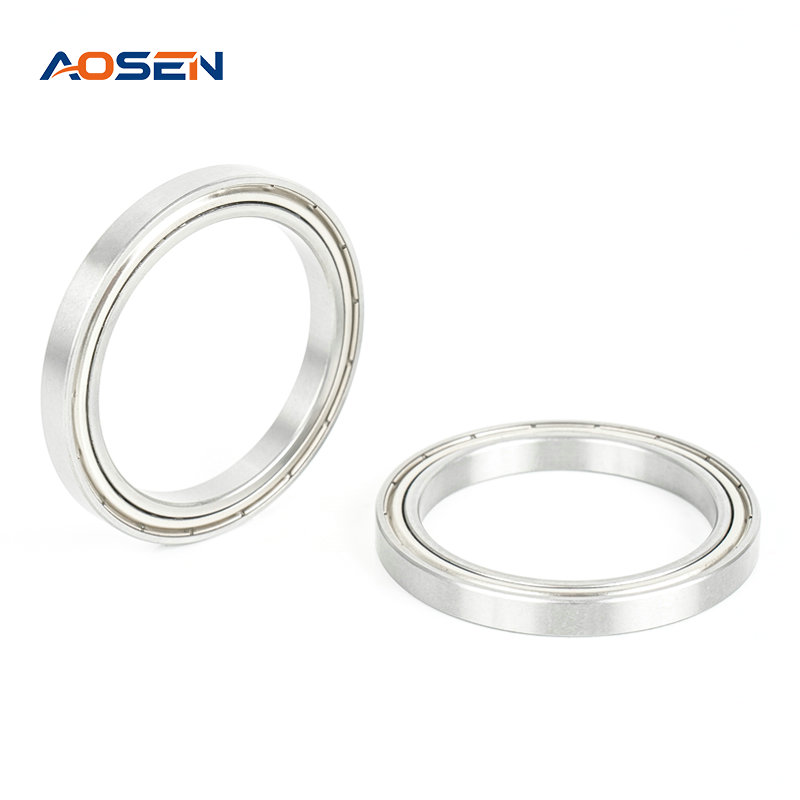
Rolamentos rígidos de esferas de aço inoxidável SS 6810 ZZ/2RS
-
 Ver mais
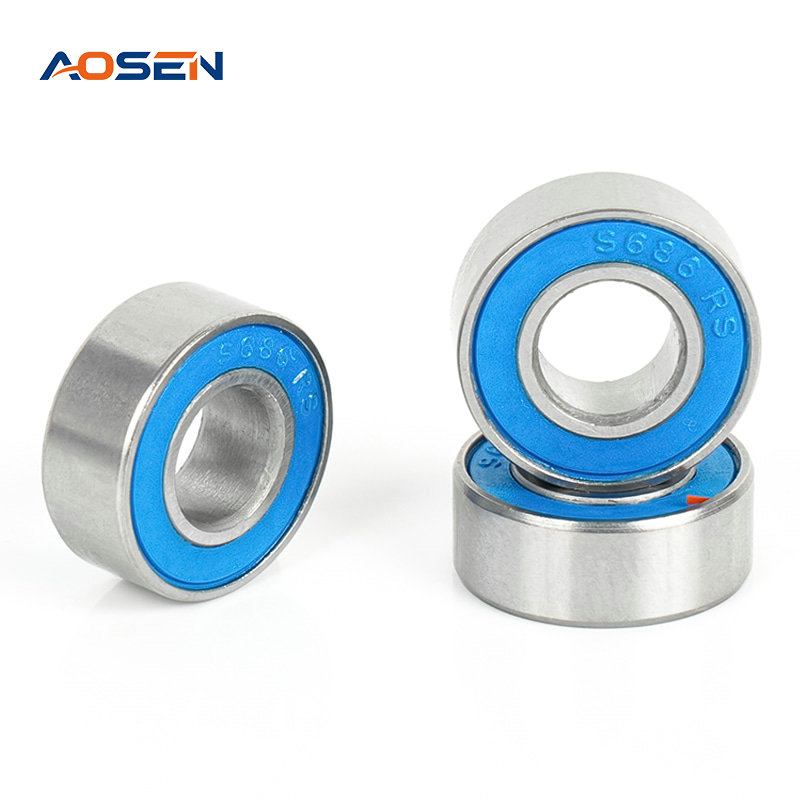
Rolamentos rígidos de esferas em aço inoxidável SS 686 ZZ/2RS
-
 Ver mais
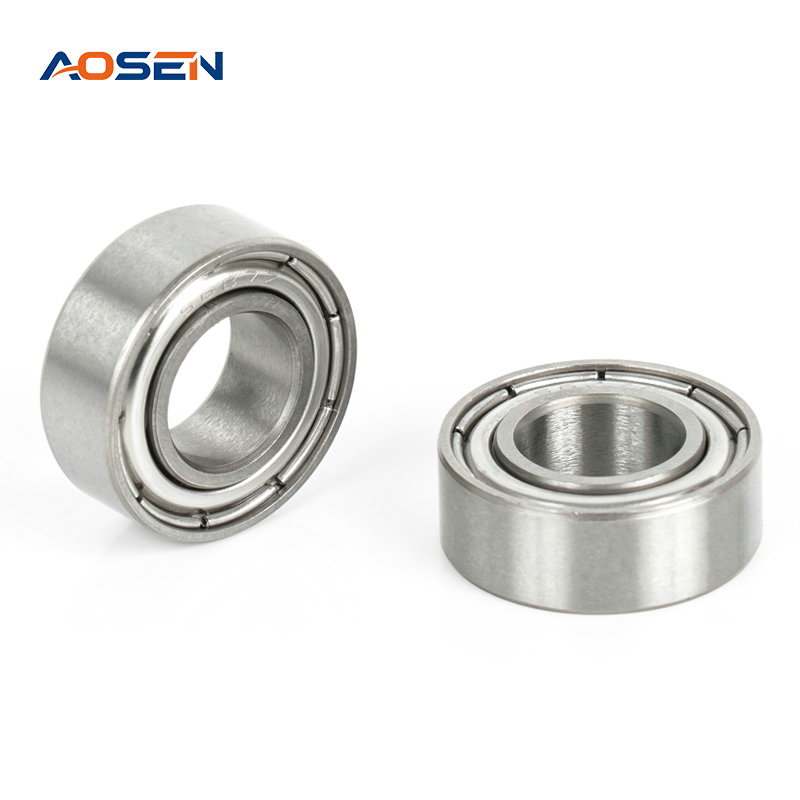
Rolamentos rígidos de esferas em aço inoxidável SS 687 ZZ/2RS
-
 Ver mais
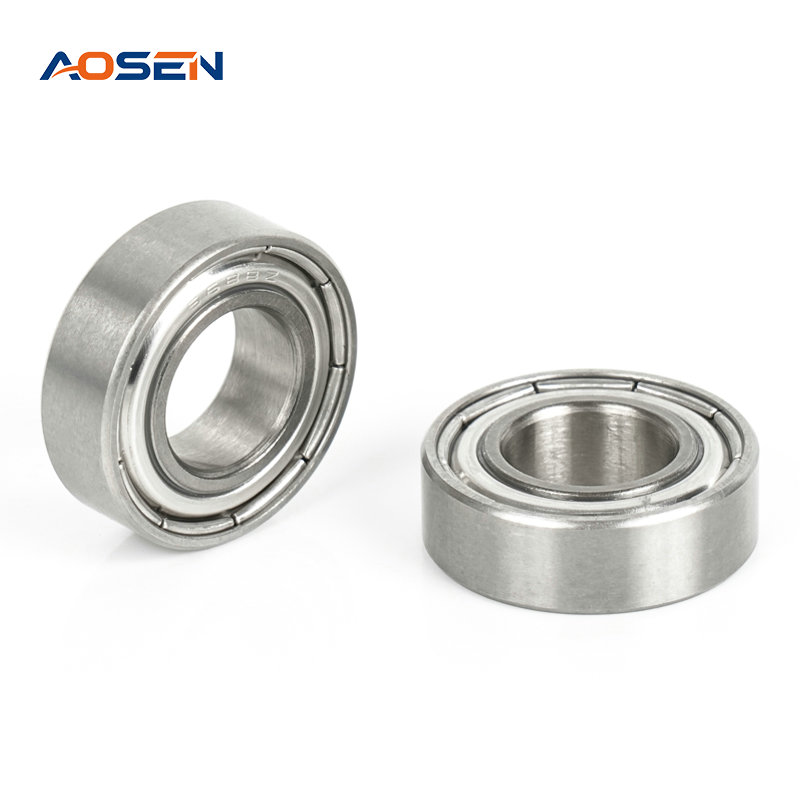
Rolamentos rígidos de esferas de aço inoxidável SS 688 ZZ/2RS
-
 Ver mais
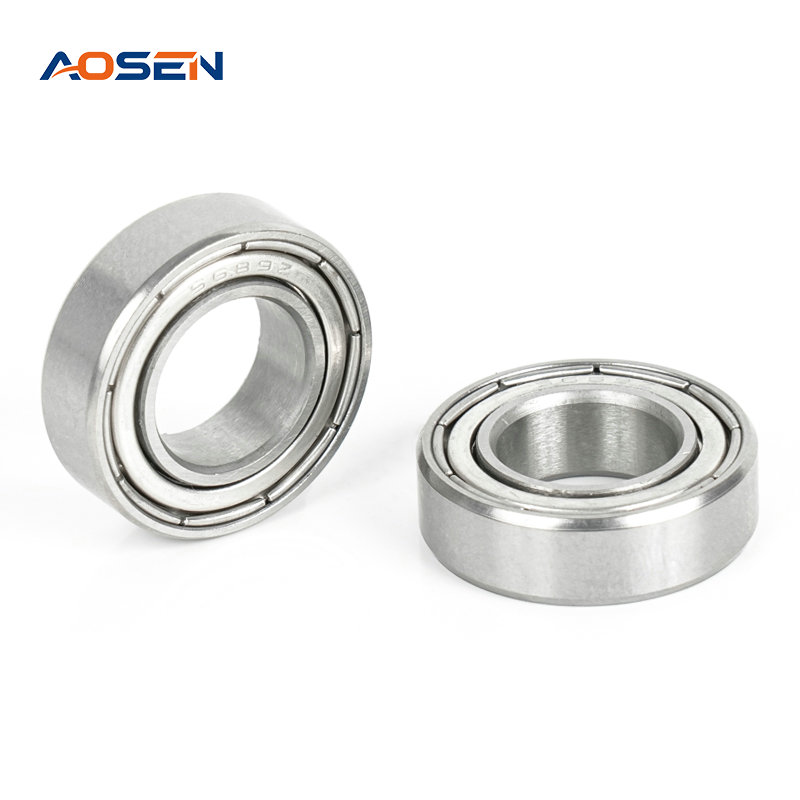
Rolamentos rígidos de esferas em aço inoxidável SS 689 ZZ/2RS
-

-
 +86-15990593443
 -
 Nº 558 Huancheng West Road, cidade de Zhouxiang, cidade de Cixi, província de Ningbo, província de Zhejiang

- Links rápidos
- Categorias de produtos
- Rolamentos rígidos de esferas
- Rolamentos rígidos de esferas de aço inoxidável
- Rolamentos de esferas de contato angular
- Rolamentos de flange
Direitos autorais @
Ningbo Aosen Bearing Co., Ltd.
